Translational and Clinical Science
Exercise and Cognitive Aging
Research Consultant · Excersize and Brain Lab, University of Maryland’s School of Public Health
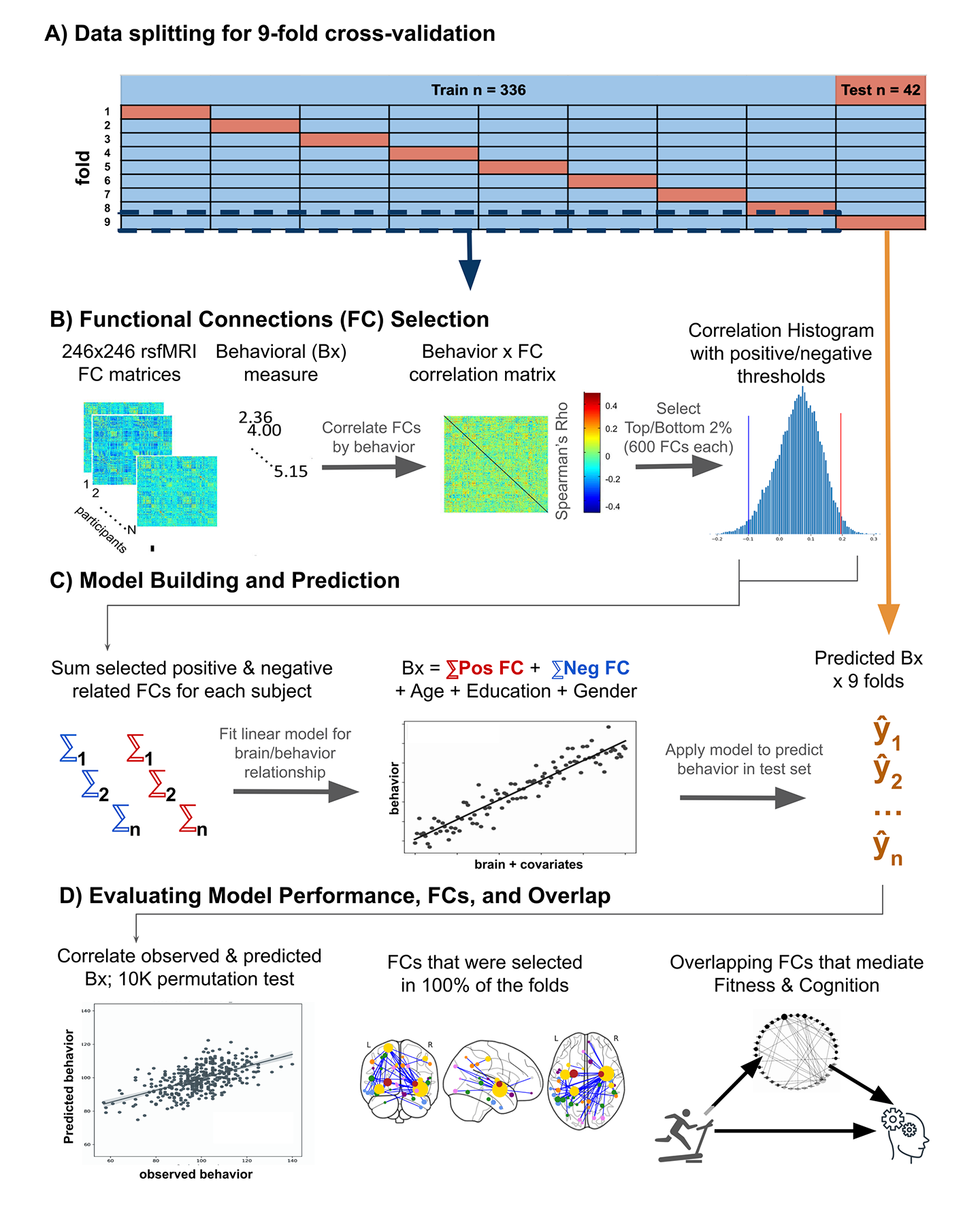
I collaborate with kinesiology researchers at UMD’s School of Public Health in developing a brain-based prediction model for understanding how fitness relates to cognitive aging.
Predictive ModelingCognitive AgingNeuroimagingBrain Networks
- Merchant, J. S., Purcell, J. J., Callow, D. D., Won, J., Kommula, Y., Rosenberg, S., … & Smith, J. C. (2025). The Functional Connectome Mediates Associations Between Fitness and Cognition Across the Adult Lifespan. Human Brain Mapping, 46(16), e70404.
Transdiagnostic Executive Function in Pediatric Psychiatry
Research Associate · Georgetown University / Children’s National Hospital
PediatricsMental HealthCognitive NeuroscienceClusteringMachine Learning</span>NeuroimagingPython</p> Psychiatric diagnostic categories are administratively convenient and biologically messy. Children with ADHD, autism, and anxiety diagnoses show overlapping executive function profiles, and the diagnosis often predicts less about a child's actual cognitive difficulties than the profile itself does. This NIH R01 — a collaboration between **Dr. Chandan Vaidya** in Georgetown University's Psychology Department and **Dr. Lauren Kenworthy**, Director of the Center for Autism Studies at Children's National Hospital — took a data-driven approach: cluster children by measured executive function rather than by diagnosis, and see whether the resulting groups map onto brain and behavioral outcomes better than the diagnostic labels do. I built and validated the clustering pipeline, and developed the end-to-end data collection and analysis protocols connecting the university lab to the hospital's clinical population — including web-based assessment tools that let clinical collaborators score and submit data directly. The resulting transdiagnostic dimensions were associated with distinct patterns of cingulate-prefrontal connectivity and with adaptive functioning, supporting a dimensional rather than categorical model of childhood psychopathology. This period is also when I founded **Brainhack Global DC**, a workshop series spanning NIH, Georgetown, and the University of Maryland. 1. Kaminski, A., You, X., Flaharty, K., Jeppsen, C., Li, S., **Merchant, J. S.**, Berl, M. M., Kenworthy, L., & Vaidya, C. J. (2022). Cingulate-Prefrontal Connectivity During Dynamic Cognitive Control Mediates Association Between P-Factor and Adaptive Functioning in a Transdiagnostic Pediatric Sample. *Biological Psychiatry: Cognitive Neuroscience and Neuroimaging*. https://doi.org/10.1016/j.bpsc.2022.07.003 1. Cook, K. M., You, X., Cherry, J. B., **Merchant, J. S.**, Skapek, M., Powers, M. D., ... & Vaidya, C. J. (2021). Neural correlates of schema-dependent episodic memory and association with behavioral flexibility in autism spectrum disorders and typical development. *Journal of neurodevelopmental disorders*, *13*(1), 1-16. 1. Loewenstern, J., You, X., **Merchant, J.**, Gordon, E. M., Stollstorff, M., Devaney, J., & Vaidya, C. J. (2019). Interactive effect of 5-HTTLPR and BDNF polymorphisms on amygdala intrinsic functional connectivity and anxiety. *Psychiatry Research: Neuroimaging*, 285, 1-8. # Neuroscience of Eating Behavior ## Project Coordinator/Lab Manager · Center for Translational Neuroscience, University of Oregon Through collaborations with the Center for Translational Neuroscience at the University of Oregon, I've examined neurocognitive predictors of behavior change. 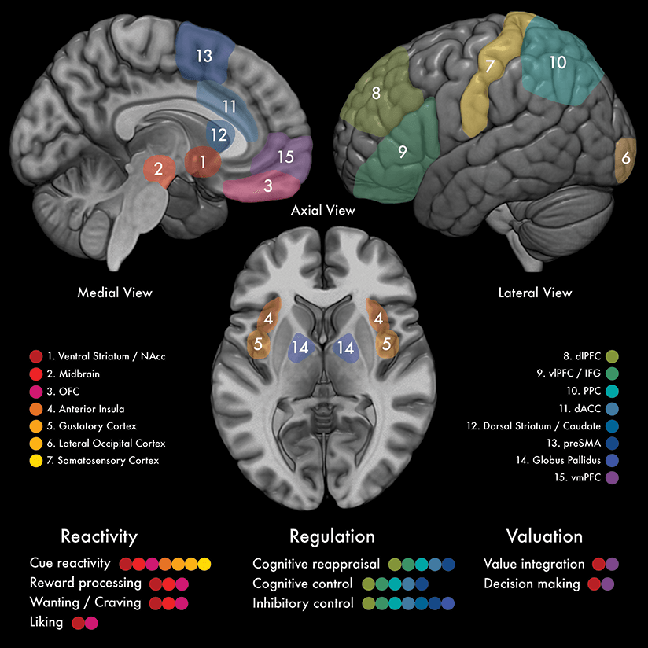Health BehaviorCognitive NeuroscienceNeuroimagingMATLAB
Why do some people successfully change their eating behavior and others do not? The Oregon Eating Study followed higher-BMI adults longitudinally, combining neuroimaging measures of food valuation and craving regulation with real-world dietary outcomes, to ask whether brain measures predict change better than self-report does. I coordinated the study — research design, recruitment, data collection protocols, and analysis — across its lifecycle, and first-authored work showing how neural substrates of food valuation relate to BMI and healthy eating in higher-BMI individuals. Related work from the group demonstrated that brain activity during craving regulation predicted subsequent changes in self-reported craving and consumption. Earlier in the same lab I co-authored work in the *Journal of Neuroscience* showing **training-induced plasticity in inhibitory control networks** — that self-regulation capacity is trainable and the change is visible in the brain. Taken together this is a body of work on habit formation, self-regulation, and behavior change measurement, which is the scientific foundation most digital health and wellness products are built on. 1. **Merchant, J. S.**, Cosme, D., Giuliani, N. R., Dirks, B., & Berkman, E. T. (2020). Neural substrates of food valuation and its relationship with BMI and healthy eating in higher BMI individuals. *Frontiers in Behavioral Neuroscience, 14*, 578676. 1. Berkman, E. T., Kahn, L. E., & **Merchant, J. S.** (2014). Training-induced changes in inhibitory control network activity. *Journal of Neuroscience, 34*(1), 149–157. 1. Giuliani, N. R., **Merchant, J. S.**, Cosme, D., & Berkman, E. T. (2018). Neural predictors of dietary change. *Annals of the New York Academy of Sciences, 1428*(1), 208–220. *(our figure made the cover for the special issue!)*