Social Cognitive Neuroscience
Computational Social Neuroscience
I am passionate about investigating the neurocognitive processes underlying social interaction using advanced computational modeling approaches!
Cognitive NeuroscienceMeta-AnalysisReproducible ResearchNeuroimagingPythonfMRIHigh-Performance Computing
Most of what we know about the social brain comes from studies where a participant looks at pictures of people. Real social interaction is different — it is contingent, it is mutual, and the other person responds to you. My dissertation asked what changes in the brain when the interaction is live.
Social Interaction Meta-analysis
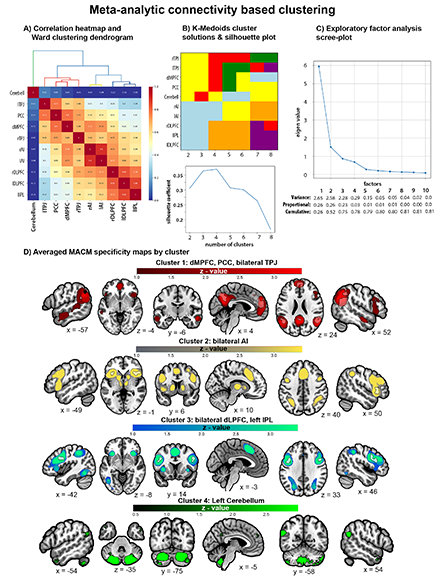
I conducted a coordinate-based meta-analysis of 108 functional neuroimaging studies that used social-interactive paradigms, implemented in the Python NiMARE framework. The synthesis established that live social behavior recruits an extended, multifunctional system rather than a single dedicated network — and clarified which regions are specific to interaction versus shared with observation and mentalizing.
Merchant, J. S., Glaros, S., Edakoth, E., Harris, R., Tchangalova, N., & Redcay, E. (2025). Brain bases of real-time social interaction: A meta-analytic investigation of human neuroimaging studies. Aperture Neuro, 5. doi:10.52294/001c.138339
Representational Similarity Analysis
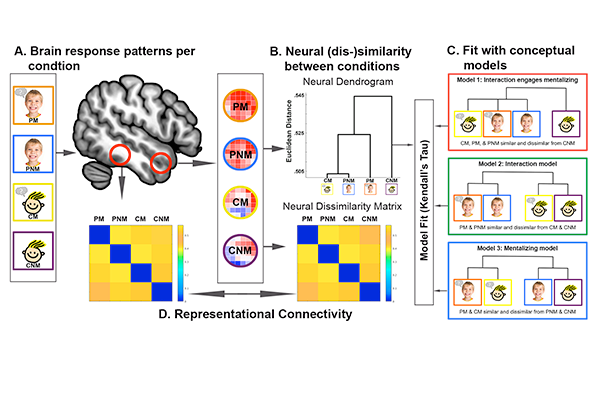
In our own data, I used representational similarity analysis to compare neural response patterns during live peer interaction against patterns during mentalizing tasks, across the transition to adolescence. The two converged in a developmentally graded way, which speaks to how the social brain reorganizes during a period when peer relationships become central.
Merchant, J. S., Alkire, D., & Redcay, E. (2022). Neural similarity between mentalizing and live social interaction during the transition to adolescence. Human Brain Mapping, 43(13), 4074–4090.
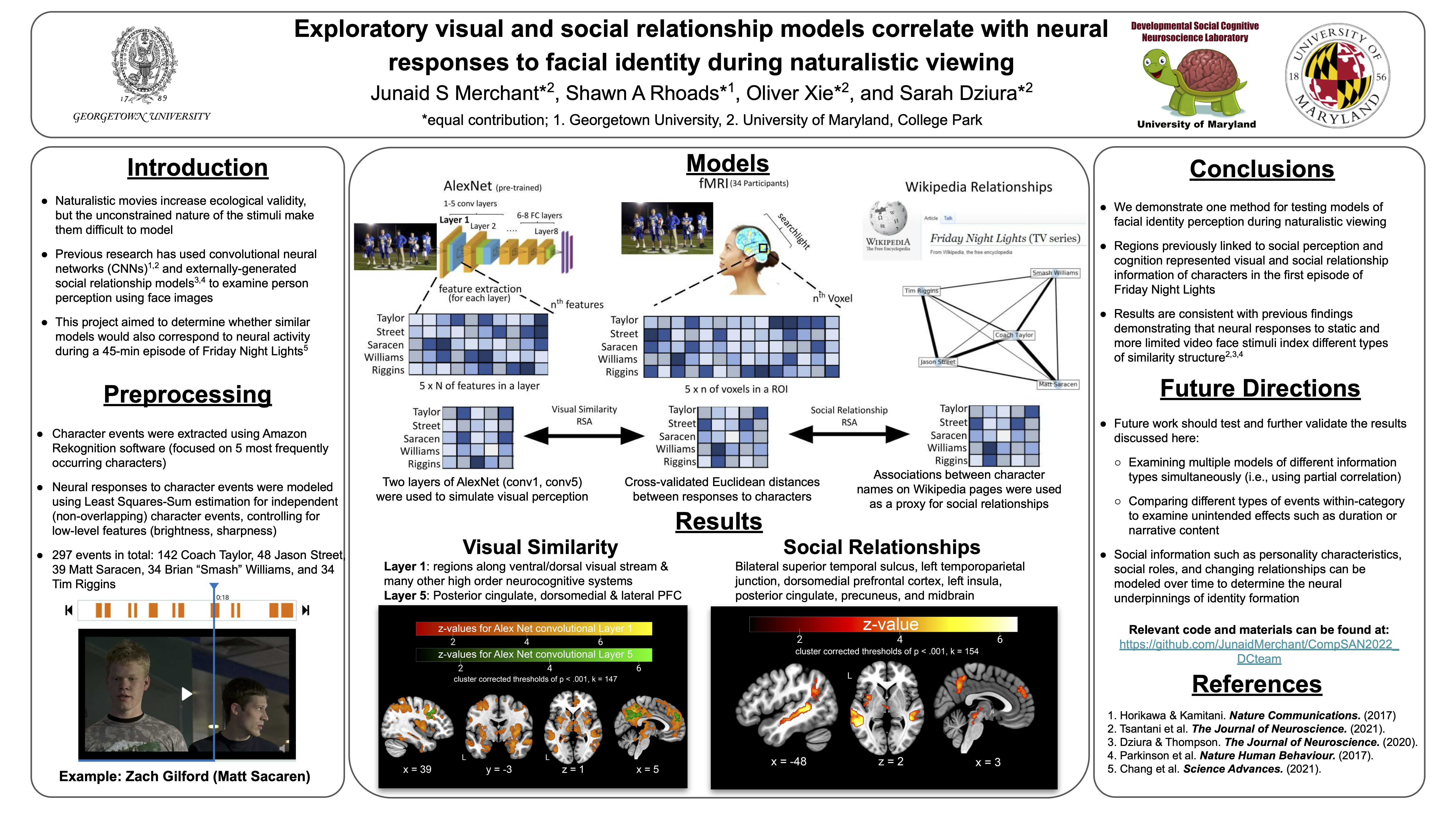
Our team won second place in the 2022 Computational Social and Affective Neuroscience Data competition
We investigatedwhether patterns of neural responses to faces of characters in a 45 minute-long dynamic film involving multiple people (viewed in a variety of orientations, lighting, movement, and clothing) correspond to representations of low-level visual features (e.g., visual similarity) and higher-level social features (e.g., social relationships) created from independent sources. We utilized Amazon’s Rekognition, AlexNet, and novel data analysis approach to examine the representation of social networks in an episode of Friday Night Lights.