Advanced Analytics
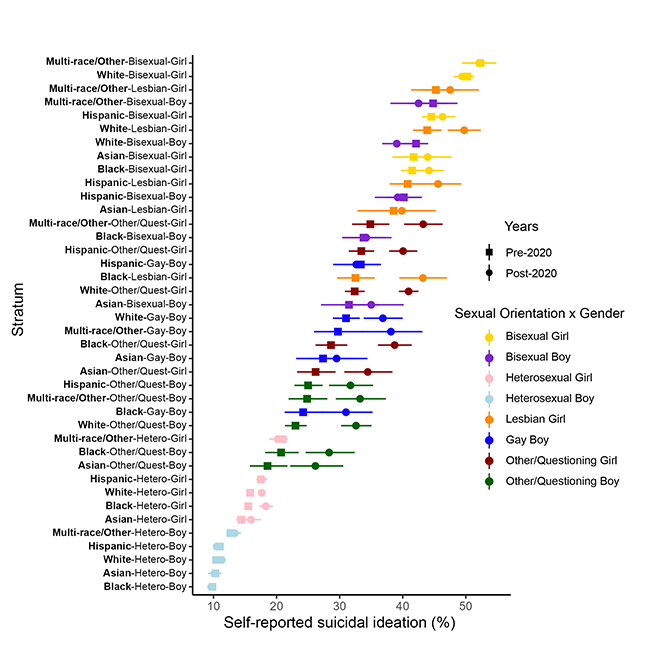
Mental health disparities among US high school students at the intersection of race, gender, and sexual orientation.
I was the lead investigator implementing multilevel modeling approaches to examine intersectional health inequities using I-MAIHDA (intersectional multilevel analysis of individual heterogeneity and discriminatory accuracy).
Mental HealthHealth EquityPublic HealthMultilevel ModelingSurvey DataRShiny
Studying one identity dimension at a time averages away the groups most affected. But splitting a survey 40 ways produces cells too small for conventional stratified analysis to say anything reliable about.
Intersectional Multilevel Analysis of Individual Heterogeneity and Discriminatory Accuracy (I-MAIHDA) resolves the tension. By treating intersectional strata as random effects rather than fixed ones, it borrows strength across strata: estimates for small cells shrink toward the grand mean in proportion to their imprecision, so you get stable estimates for all 40 combinations instead of noisy ones for a few and nothing for the rest. It also partitions how much of the variation is additive versus genuinely interactive — which turns “does intersectionality matter here?” from a theoretical argument into a measurable quantity.
I applied this to suicidal ideation among U.S. high school students in the CDC’s Youth Risk Behavior Survey, across 40 combinations of race, gender, and sexual orientation, comparing waves before and after 2020. The results showed a considerably more nuanced pattern than single-axis analyses had suggested, and identified which groups absorbed the most of the 2020 disruption.
Related work extended the framework to examine how state-level policy environments shape youth mental health outcomes across intersecting identities.
Making it usable
Methods papers get cited; tools get used. I built and deployed an interactive Shiny application so researchers, policymakers, journalists, and advocacy organizations can explore the intersectional estimates directly — no statistical training and no model fitting required.
Intersectional Youth Mental Health Interactive (preview):
Publication
Merchant, J. S., Nguyen, T. T., Makres, K., & Evans, C. R. (2025). Intersectional inequities in suicide ideation by race, sexual orientation, and gender among US high school students in the pre- and post-2020 waves of the YRBSS: an application of random effects intersectional MAIHDA. American Journal of Epidemiology, 194(9), 2540–2552. doi:10.1093/aje/kwaf114
Published in a special issue on methods in social epidemiology.
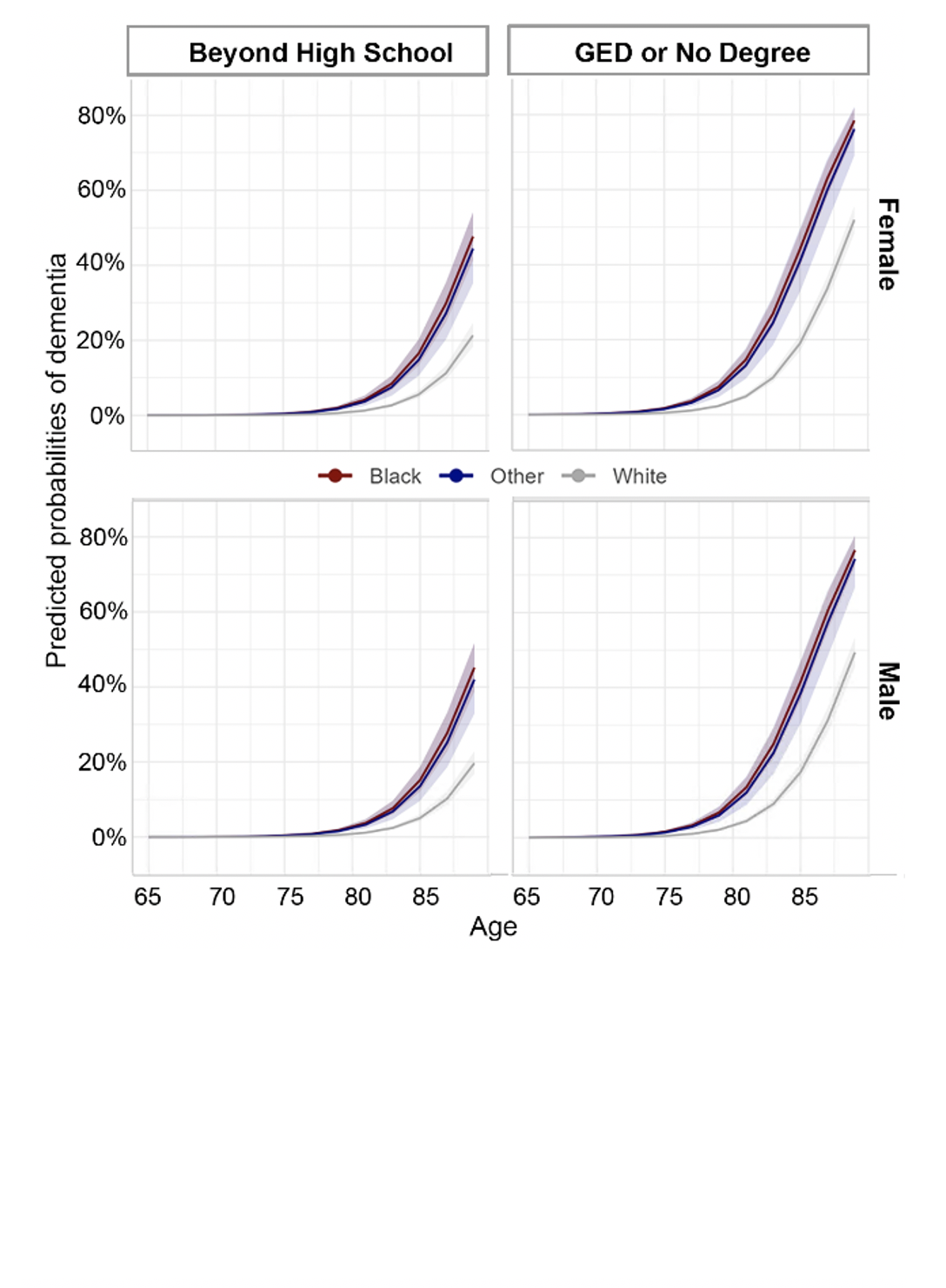
Intersectional Differences in Cognitive Aging Trajectories.
Currently working on expanding the I-MAIHDA approach to examine longitudinal cognitive aging data in the Health and Retirement study data. So far, we’re finding differences in the onset of dimentia between the ages of 70-75 at the intersection of race, gender, and education.